

Hey there! As a supplier of HMI (Human-Machine Interface) sizes, I often get asked about the standard HMI size for industrial applications. It's a question that doesn't have a one-size-fits-all answer, and in this blog, I'll break down the factors you need to consider and some popular sizes in the market.
Factors Affecting the Choice of HMI Size
1. Application Complexity
The complexity of the industrial application plays a huge role in determining the appropriate HMI size. If you're dealing with a simple application, like a small-scale manufacturing unit that only requires basic monitoring and control of a few parameters, a smaller HMI might do the trick. For instance, a system that just needs to show the temperature and pressure of a single machine can work well with a compact HMI.
On the other hand, if you're managing a large industrial plant with multiple processes, numerous sensors, and complex control algorithms, you'll need a larger HMI. A big HMI can display more information at once, allowing operators to have a comprehensive view of the entire system. They can easily monitor different aspects like production rates, equipment status, and alarm notifications without having to constantly switch between screens.
2. Space Constraints
Physical space is another crucial factor. In some industrial environments, space is at a premium. For example, in a small control cabinet or a mobile vehicle used in the industry, there might not be enough room for a large HMI. In such cases, a smaller HMI size becomes a necessity. It can be easily installed without taking up too much space and still provide the necessary functionality.
Conversely, in a large control room where operators have plenty of space to work, a larger HMI can be installed. It can be placed on a desk or a console, providing a comfortable viewing experience for the operators.
3. Operator Interaction
How operators interact with the HMI also affects the size choice. If the HMI is mainly used for simple tasks like viewing data or pressing a few buttons, a smaller size might be sufficient. However, if operators need to perform complex tasks such as drawing diagrams, entering long codes, or zooming in and out of detailed information, a larger HMI is preferable. A bigger screen gives them more space to work and reduces the chances of making errors.
Popular HMI Sizes for Industrial Applications
1. 4.3 Inch HMI
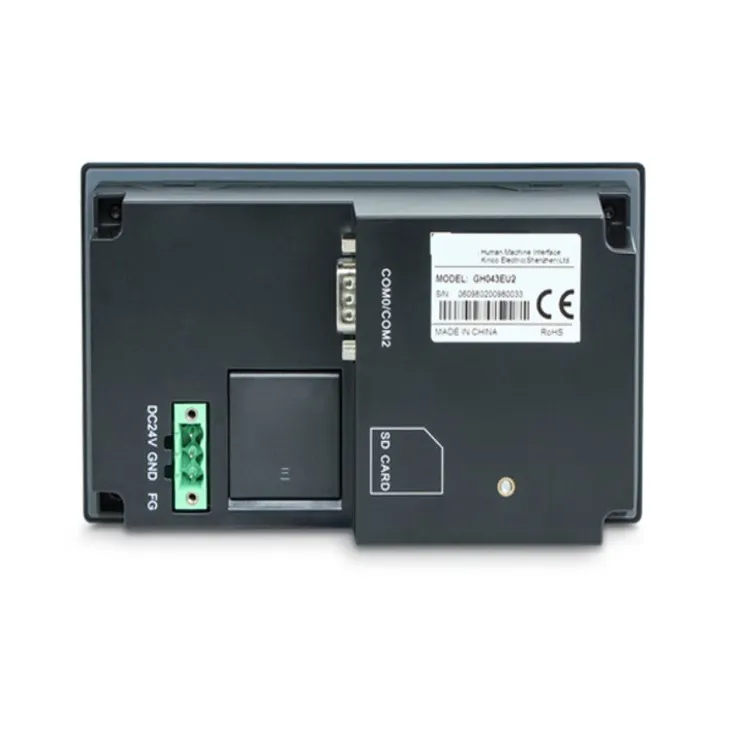
The 4.3 Inch HMI is a popular choice for applications where space is limited. It's small and compact, making it ideal for use in small control panels or portable devices. Despite its small size, it can still provide basic functionality such as displaying real-time data, simple graphics, and allowing operators to perform basic control tasks. For example, it can be used in small-scale automation systems, like a single-machine control unit in a workshop.
2. 12.1 Inch HMI
The 12.1 Inch HMI strikes a good balance between size and functionality. It's large enough to display a decent amount of information without being too bulky. This size is suitable for medium-sized industrial applications, such as a local control station for a group of machines in a factory. Operators can view multiple data points and control different functions on a single screen, improving efficiency and reducing the need for frequent screen switching.
3. 15.6 Inch HMI
The 15.6 Inch HMI is a great option for large-scale industrial applications. It offers a wide viewing area, allowing operators to have a detailed and comprehensive view of the entire system. It can display complex graphics, multiple windows, and a large amount of data simultaneously. This size is commonly used in control rooms of power plants, large manufacturing facilities, and transportation systems, where operators need to monitor and manage multiple processes at once.
Customization and Standardization
While there are these popular standard sizes, it's important to note that customization is also an option. Some industrial applications have unique requirements that can't be met by standard HMI sizes. In such cases, we can work with you to develop a custom-sized HMI that fits your specific needs. Whether it's a non-standard shape, a particular resolution, or special features, we can design an HMI that's tailored to your application.
However, standard sizes also have their advantages. They are more readily available, which means shorter lead times for delivery. They are also generally more cost-effective since they are mass-produced. So, if your application can be served by a standard HMI size, it might be a better choice in terms of cost and availability.
Making the Right Choice
When it comes to choosing the right HMI size for your industrial application, it's important to carefully evaluate your specific requirements. Consider the factors I've mentioned above, such as application complexity, space constraints, and operator interaction. You can also consult with an expert in the field. As a supplier, we have a lot of experience working with different industrial applications, and we can provide you with valuable advice based on your needs.
If you're still not sure which HMI size is right for you, feel free to reach out to us. We can have a detailed discussion about your application, understand your requirements, and help you make an informed decision. Whether you need a small, compact HMI or a large, high - resolution one, we've got you covered.

Conclusion
In conclusion, there isn't a single standard HMI size for all industrial applications. The choice depends on a variety of factors, and different sizes are suitable for different scenarios. The 4.3 Inch HMI is great for space - limited and simple applications, the 12.1 Inch HMI offers a good balance for medium - sized setups, and the 15.6 Inch HMI is ideal for large - scale and complex systems.
If you're in the market for an HMI and need help with choosing the right size or have any other questions, don't hesitate to get in touch. We're here to assist you with all your HMI needs and make sure you get the best solution for your industrial application.
References
- Industrial Automation Handbook, [Author's Name], [Year of Publication]
- HMI Design Guidelines for Industrial Applications, [Research Institute], [Year of Publication]